The October 25, 2026 Draws at a Glance
Sunday draws in the PCSO calendar carry a different rhythm than weekday games. More casual players buy tickets on Saturday night and Sunday morning, the queues at authorized lotto outlets stretch longer, and the prize pools for the two biggest games tend to look heavier than they did on Friday. October 25, 2026 followed that pattern exactly, and the results are laid out in the table above for anyone who wants the raw digits first.
For beginners, the important framing is this: the PCSO ran two draws that evening, the 6/58 Ultra Lotto and the 6/49 Super Lotto. Both are six-number games with no bonus ball, meaning your ticket either matches the exact six-number combination drawn or it does not. There is no partial-match consolation at the top tier, though both games pay smaller prizes for three, four, and five correct numbers.
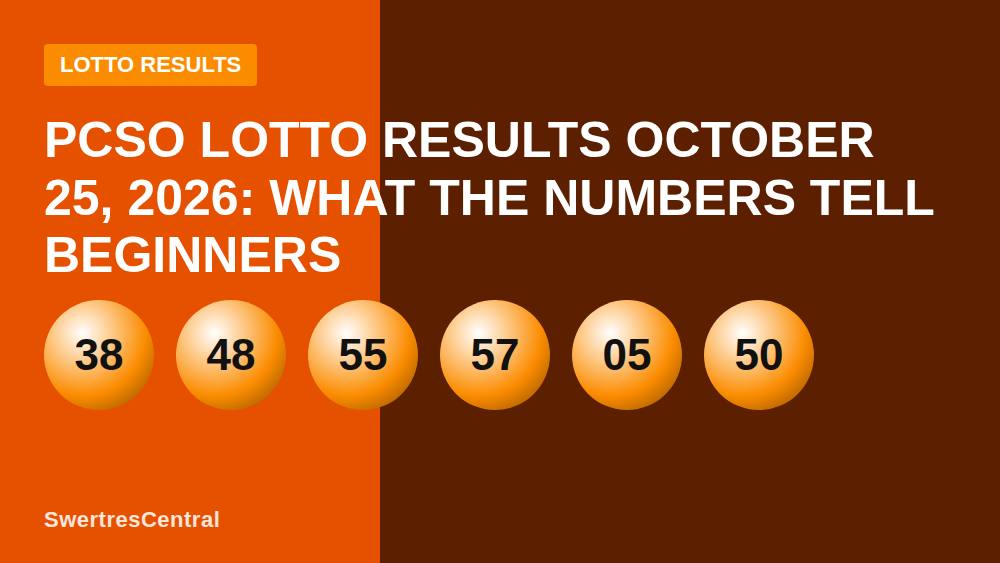
The Ultra Lotto combination came out as 38-48-55-57-05-50, and the Super Lotto combination landed at 49-38-12-07-33-34. Notice how 38 appeared in both draws on the same night. That kind of overlap happens more often than beginners expect, and it is one of the reasons regulars keep a running log of results rather than treating each draw as an isolated event.
Neither game produced a jackpot winner, which means both prize pools roll over into the next scheduled draw for that game. The Ultra Lotto jackpot stood at ₱440,654,674.87, and the Super Lotto jackpot sat at ₱66,732,591.64. Those are the figures printed in the table above, and they are the numbers that matter when you decide whether the next draw is worth a ticket.
| Game | Winning combination | Jackpot (PHP) | Winners |
|---|---|---|---|
| 6/58 Ultra Lotto | 38-48-55-57-05-50 | 440,654,674.87 | |
| 6/49 Super Lotto | 49-38-12-07-33-34 | 66,732,591.64 |
Reading the Ultra Lotto Combination Like a Regular
Take the Ultra Lotto set apart for a moment: 38, 48, 55, 57, 05, 50. Sorted ascending, that is 05-38-48-50-55-57. The spread runs from the single digits straight up to the high fifties, with a noticeable cluster in the 48–57 band. Three of the six numbers sit within a nine-point window, which is a shape seasoned players call a cluster draw.
Why does that matter to a beginner? Because most first-time players instinctively spread their picks evenly — one number from each decade, say 05, 15, 25, 35, 45, 55. That looks balanced on paper but it ignores how real draws behave. Clusters are common. Gaps are common. The 6/58 machine does not care about aesthetics.
What the October 25 Ultra Lotto result shows is a combination with a low anchor (05), a mid-range pair (38, 48), and a dense high-end cluster (50, 55, 57). If you are building a slip for the next Ultra Lotto draw, one defensible approach is to mirror that architecture — one or two low numbers, a couple in the middle, and a tight group at the top — rather than forcing a perfectly even spread.
Another detail worth noting: the sum of the six Ultra Lotto numbers is 253. The average sum across all possible 6/58 combinations lands in the low 180s, so this draw sat well above the middle of the distribution. High-sum draws are not rare, but they are less crowded. Fewer players build slips with sums above 240, which means a win on a combination like this one would have been shared among a smaller field — a real consideration when the jackpot is already north of ₱440 million.
Super Lotto: A Lower Spread, A Different Shape
The Super Lotto result reads 49-38-12-07-33-34, or sorted: 07-12-33-34-38-49. Where the Ultra draw skewed high, this one stretches across the full 1–49 range with a clear pair at 33 and 34. Consecutive numbers are one of the most argued-about features in Philippine lotto circles — some players avoid them on the theory that the machine rarely produces neighbors, and the October 25 Super Lotto draw is a tidy counterexample.
The sum here is 173, right around the statistical middle for a 6/49 game. That means this combination sits in the most heavily played territory. Had someone matched all six, the ₱66,732,591.64 prize would almost certainly have been split. This is the trade-off every beginner should understand early: comfortable-looking combinations get played by more people, so the jackpot gets divided. Unusual-looking combinations get played by fewer people, so the same jackpot stays intact.
The overlap with the Ultra draw — 38 again — is the sort of coincidence that fuels pattern-hunting. Treat it as entertainment rather than strategy. Two independent machines drawing on the same evening share no memory, and 38 appearing twice is simply a 38 appearing twice.
What the Rollover Means for Your Next Ticket
Because neither game produced a jackpot winner on October 25, both pools carry forward. The Ultra Lotto's ₱440,654,674.87 will grow again before the next draw, and the Super Lotto's ₱66,732,591.64 will do the same. Rollovers are the single biggest driver of ticket sales in the PCSO system, and they change the math in a way beginners should appreciate.
At a ₱20 base play for the 6/58 game, your cost per combination does not move when the jackpot climbs. The prize, however, does. That asymmetry is the whole appeal of playing a rolled-over draw — the same ₱20 buys exposure to a larger pool. The catch, of course, is that bigger jackpots attract more players, which raises the chance of a split if you do win.
Practical guidance for a first-timer:
- Set a hard budget before you queue. ₱100 to ₱200 per draw is a sane ceiling for casual play. The odds of matching all six numbers in 6/58 are 1 in 40,475,358, and no jackpot size changes that.
- Use a system slip only if you understand the cost. A 7-number system for 6/58 covers 7 combinations at ₱20 each, so ₱140. An 8-number system jumps to 28 combinations, or ₱560.
- Keep your tickets. PCSO prizes are claimed at branch offices and the ticket is the only proof. Sign the back of your slip.
- Check results the morning after. Draws air in the evening, but verifying the next day against a written record avoids the panic of a misplaced slip.
Prize claiming follows the standard PCSO schedule: amounts up to ₱20,000 can be claimed at authorized lotto outlets, while larger prizes go through PCSO branch offices or the main office in Mandaluyong. Claims must be filed within one year of the draw date, after which the prize is forfeited to the charity fund.
Building a Beginner's Routine Around These Results
The most useful habit you can build after a draw like October 25 is a simple results log. Write down the date, the game, the six numbers, and the jackpot figure. Do it for a month and you will start to see the texture of the games — how often clusters appear, how often consecutive pairs show up, how the sums distribute. None of this improves your odds on any single ticket, but it does make you a more deliberate player rather than someone picking birthdays every week.
For the next Ultra Lotto draw, a reasonable template based on the October 25 shape would be one number from 01–15, two from 16–40, and three from 41–58. That mirrors the architecture that actually came out. For the Super Lotto, consider allowing at least one consecutive pair, since the 33-34 pairing showed the machine is perfectly willing to produce neighbors.
If you play through online betting platforms rather than physical outlets, apply the same discipline. Reputable operators licensed under PAGCOR carry a minimum deposit of ₱100 to ₱200, offer a first-deposit match of 100% up to ₱1,000 with a 5x wagering requirement on the bonus, and process withdrawals within 24 to 48 hours to GCash, Maya, or your bank. VIP tiers typically begin at ₱50,000 in lifetime turnover and unlock faster cash-outs and higher daily withdrawal caps.
One more note for the beginners in the crowd: the draw is entertainment with a charity component, not an income plan. The PCSO directs a substantial share of proceeds to health programs and medical assistance, and the games are designed to fund that mandate. Play what you can afford to lose, and treat a win as a bonus rather than a schedule.